Catholic Living
Decoding the Widow's Mite
Fr. Samuel Keyes
Why does the widow put her two coins into the treasury?
That is the question. All the rich men, they give out of their abundance-generously, in an absolute sense, but only out of what they consider expendable. I remember a fascinating conversation at coffee hour in an Episcopal group in New England, some years ago, discussing the idea of the tithe (a tithe is, by the way, a tenth-that’s just what the word means), and a certain British gentleman commented to me that surely that is 10 percent of one’s readily available income. I am not completely sure what he meant; certainly, tithing doesn’t mean you cut off and sell a tenth of your house every year, or something like that. But if he meant that the tithe was meant to be simply a portion one’s disposable income after all the bills have been paid, etc., I think he may have missed the point. For the ancient people of God, the tithe was the tithe; whether it was money from trade, or fruits of the harvest, one gave the first portion to God. Not a piece of the leftovers. Without too much stretch, we might translate this as follows: give your first hour’s wages to God, whatever that may be.
But still, there’s the question of why. For the rich men in the Temple, we might translate the why into today’s terms: perhaps there is a tax benefit to giving a certain amount. Perhaps by giving a certain amount they will please an important patron or board member. Perhaps they give, in a simple way, because they want to and because they can. There is no judgment necessary here: in highlighting the widow’s gift, Jesus is not suggesting that the other gifts are meaningless or unworthy.
But the why does matter in the end. The widow gives, Jesus says, not out of her excess, but out of her substance-in fact, she gives all that she has. So, for her, the donation is not merely an act of supporting some cause that she likes, at a time when she has some money to spare that maybe needs to go to a good cause. For her, this is an act of personal faith: she is giving not just her coins, but her own hope of health and well-being. For her, this small amount is of far greater significance than the larger amounts given by others.
It’s an act of faith, but also, I think, of joy. People give sometimes out of obligation. People give sometimes with a sense of self-interest. But this one gives willingly, almost as if she were not the true owner.
And there we have the key: this power of gift. St. Paul writes in 1 Corinthians 4: “What have you that you did not receive? If then you received it, why do you boast as if it were not a gift?” If God’s grace-God’s gifts and favor toward us-is a constant theme for Paul, it is also the constant theme of the whole Bible. Genesis begins with grace: with God’s creation out of nothing, his gift of life to all creatures, his gift of divine dignity and freedom to humanity. The widow of Zerephath in 1 Kings receives God’s unexpected gift of food. Revelation ends with grace-with the heavenly city descending to the new earth, where God will dwell with his people together.
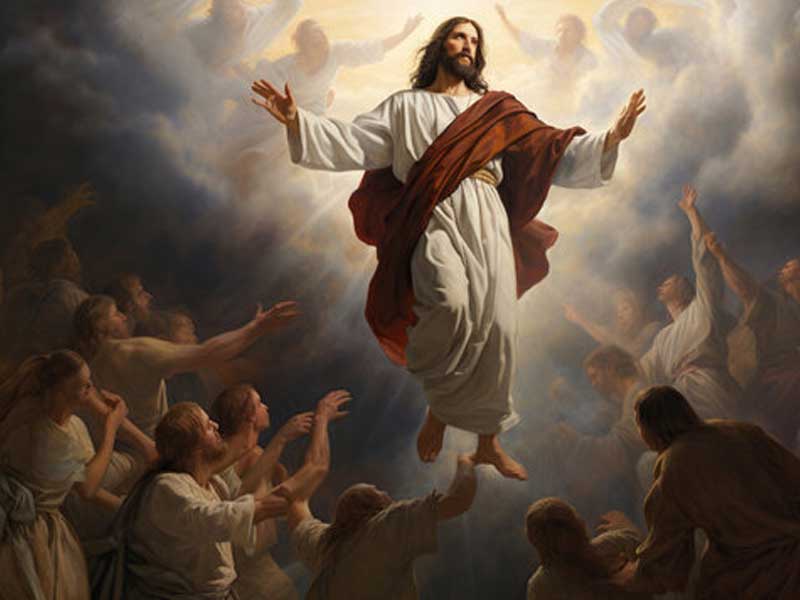
And in the middle, at the crossroads of history, we find Jesus: the incarnate Son of God, who gives the world himself. Our reading from Hebrews speaks of this gift and its unique character. It is a sacrifice unlike any other, because it is total, complete, and forever. We remember it at every Mass; we make it present once again, we offer again-in an unbloody way-the once-for-all sacrifice of Christ, presenting before God God’s own flesh and blood for the renewal of creation. Grace upon grace upon grace.
We can legitimately celebrate the right to private property-a right the Catholic Church affirms-and take a real and rational pleasure in the work that we do in building up treasure, so to speak, in this world, whether for ourselves or for following generations. So tradition is clear that we need not take from the widow’s mite some kind of universal rule of poverty, much less some kind of Marxist deconstruction of the value of individual work. But the spiritual principle is quite real, and no less powerful: in an absolute sense, from the perspective of eternity, we own nothing. We come into this world empty-handed, and we take nothing with us when we leave. The Christian concept of “stewardship” is a reminder of this. We are, as human beings, stewards of creation. We are also stewards of the resources we have at the present time. But they do not finally belong to us; they belong to our Lord and Master.
I think some of the great benefactors and philanthropists among the very rich have understood this. And many people in great poverty understand this as well, which is why charitable giving among the poor remains, even today, much more common than it is among those with more. It is those of us somewhere in the middle who find it hard, probably because we convince ourselves that being comfortable is the same thing as being good stewards.
There was risk involved in God’s self-gift to us-first in creation, and then even more in the incarnation. This risk is obvious-we see it fully on the cross. Giving us himself meant being vulnerable. Do we think, then, that following this Lord will involve no risks? Do we think it will be safe? Do we think it will make demands only on our leftovers, on our spare time, on the parts of life that we already happen to have available? As C.S. Lewis reminds us, Aslan is not a tame lion. This Lord who suffered death for us is not very interested in a half-hearted faithfulness.
We know that stewardship is much more than money-it is also about time, energy, resources, talent. In all these things, God wants our first fruits, not our leftovers. Christianity is not a part-time club, but an all-consuming romance. If we all acted on this truth, with a whole heart, imagine the power of such witness in a world aching for the touch of divine grace.

















.jpg)